

















The Significance of a Clearinghouse Goes Beyond What Meets the Eye
A clearinghouse in medical billing plays a crucial role in ensuring accurate and timely reimbursement. It is an important part of revenue cycle management that healthcare providers and practices cannot ignore. Outsourced billing services can help providers and practices in this situation.
Effective claim processing is the product of proper clearinghouse activity. It takes your billing process one step ahead and helps in achieving a boosted bottom line. Every healthcare provider and practice must pay attention to it if they are not already doing it.
Explore this blog to know more about clearinghouses, clearinghouse services, and how they improve medical billing for healthcare professionals from different medical specialties.
What Is a Clearinghouse in Billing Administration?
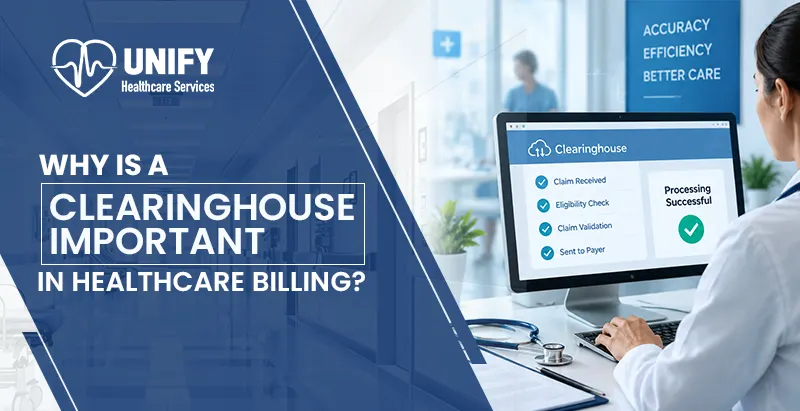
A clearinghouse is an intermediary between healthcare providers and insurance payers. It can either be a technology or a service company that simplifies claim processing. Its role is improving claim submission through a standardized process. The focus stays on identifying errors and missing information through electronic checks. But that’s not all; clearinghouses are an important aspect of moving medical claims to the next stage of claim processing.
How Does a Clearinghouse Affect Healthcare Revenue?
Clearinghouses and healthcare revenue are directly connected with the real impact on healthcare providers. Clearinghouses decide the fate of claims and ensure that
- Claims reach the right payer
- Claims don’t go to the next step with errors
- Claim rejection is avoided at the right time
- The claim process is completed within time
- Remittance advice and claim-status inquiries are complete
However, clearinghouses don’t guarantee complete revenue. All it does is simplify the process and strengthen the possibility of reimbursement. It makes the process smooth for healthcare providers and practices.
Are There Any Complexities Related to Clearinghouse?
Yes, there are complexities related to clearinghouses during claim processing. Awareness prepares healthcare providers to make better decisions and improve their administrative processes.
Payer-Specific Claim Requirements
Claim requirements may vary depending on insurance payers with different submission rules. The claim format can be different and managing that can be difficult.
Claim Rejections and Submission Errors
If your claims have errors or missing details, the clearinghouse will reject your claims. After that, you have to identify what’s wrong with your billing process.
Payer-Specific Claim Edits
Clearinghouses make edits to your claims before transmission, but these edits can be flagged by different payers. This makes the process complex.
Recurring Clearinghouse Issues
If your workflow is not going strong, then it means there are repeated complexities in the billing process.
In order to reach the final billing step, payment posting, healthcare professionals have to find ways to improve their revenue cycle management.
What are the Steps in Clearinghouse Process?
| STEPS | WHAT HAPPENS? |
| Claim Creation | Patient, insurance, diagnosis, procedure, and billing details are added to the claim. |
| Claim Submission | The claim is electronically sent to the clearinghouse. |
| Claim Checking | The clearinghouse checks for certain errors, missing information, and payer-specific requirements. |
| Claim Routing | The claim is electronically routed to the appropriate payer. |
| Payer Review | The payer reviews the claim and determines payment, rejection, or denial. |
| Response & Follow-Up | The response comes back electronically for the billing team to review and act on. |
How Can Professional Support Make Clearinghouse Management Easier?
In general, clearinghouse management includes dealing with various payers, claim rejections, claim edits, and more. However, all the struggle comes to an end when healthcare providers partner with experienced medical billing professionals.
Professional billing simplifies claim management, tracking, and improvement. It helps you keep the process organized and smooth, allowing healthcare providers and practices to keep the billing process moving.
Conclusion
Even though clearinghouses are not mandatory for healthcare providers, it is an important step to ensure efficiency. With the right clearinghouse support, healthcare providers can benefit from the process. If you partner with services, it enhances payer connectivity, claims expertise, responsiveness, security, and specialty experience. It reduces operational disruptions and improves the revenue cycle.
Unify Healthcare Services brings medical billing experience to help healthcare providers manage their revenue cycle. Our team can support the claims process, solve billing challenges, monitor claim management, perform claim scrubbing, and help practices acquire complete revenue.
Frequently Asked Questions
Clearinghouse service is not mandatory for healthcare providers and practices. But it adds a layer of accuracy to your medical billing process. It makes sure your claims are accurate before they are submitted to payers. As a result, healthcare providers can achieve a higher clean claims rate and improve their revenue cycle management.
Partnering with professionals for a process like clearinghouse helps you overlook complexities and achieve results without any hassle. Moreover, experts help identify deeply rooted billing issues in your practice, helping you solve them. There is more control over the process and better handling.
Unify Healthcare Services helps providers with their medical billing and coding process. They make sure every step is done correctly. Their efforts ensure higher accuracy and efficiency during medical billing. They also help providers with distinct payer requirements, ensuring maximum revenue and operational flow.
A clearinghouse acts as an electronic intermediary between healthcare providers and payers. Whereas claim scrubbing is a process of checking claims for errors before claim submission. While the two sound very similar, they are not the same type of process.
There is no single timeframe for every claim. Processing time can vary based on the payer, claim type, electronic submission, required information, and whether the claim encounters a rejection or denial.